Ekorn — AI-assisted suitability reports — Cinthia Sokoloski
C Cinthia Sokoloski Product Designer
01Ekorn In development · Sep 2026

Designing AI-assisted suitability reports

Suitability reports are a mandatory part of financial advice, explaining why a recommendation is appropriate for a client's circumstances and objectives. At Ekorn, producing one meant leaving our platform for a third-party AI tool, editing the output in Word, then returning to continue onboarding.

I led product design across the project — from early workflow definition and user research through prototyping and validation — and worked with product and engineering to define how source documents, AI extraction and the report template connect.

Role
Sr Product Designer
Status
Launching Sep 2026
Users
Advisers · Paraplanners · Admin
Platform
Web

Target metrics

Measured post-launch · Sep 2026
Time saved
30%

reduction in average time on the report step

Completion
90%

of started migrations reaching report sent

Adoption
80%

native Ekorn report adoption within 6 months
01Upload documents 02Review details 03View report 04Download
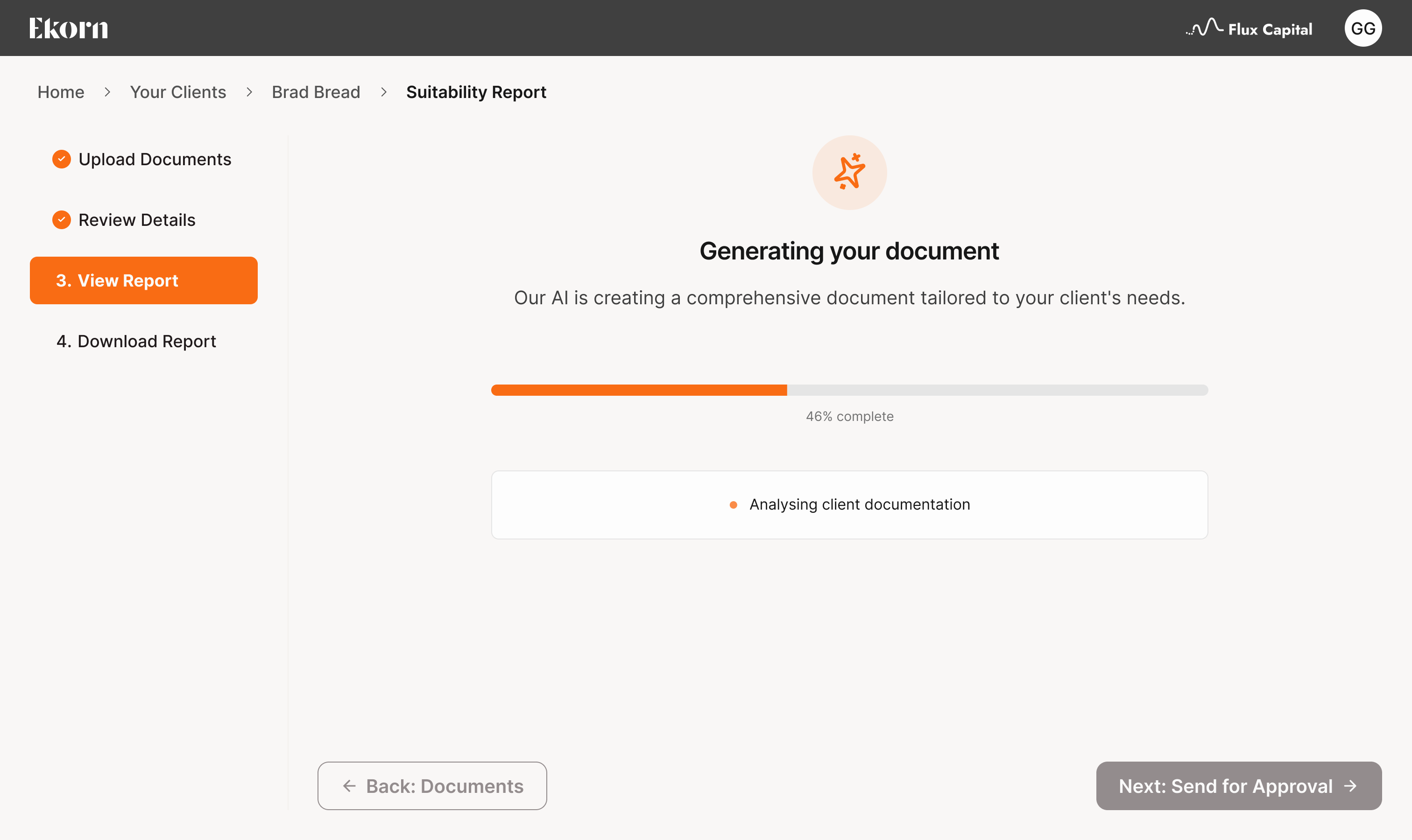
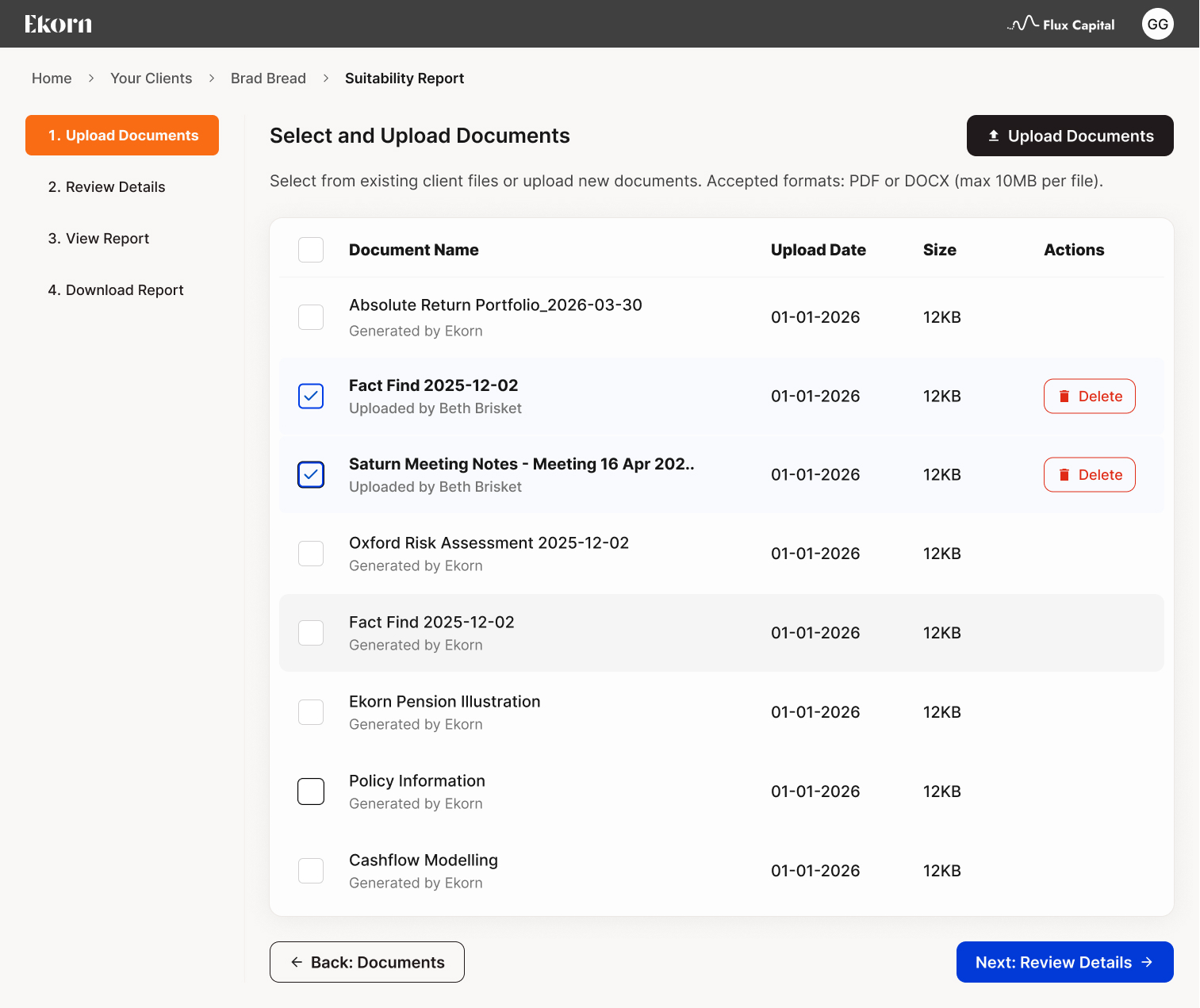
Select & upload documents. Choose from existing client files or upload new ones; with joint clients, every file is attributed to an owner. Review details. The AI's client summary, investment profile, goals, recommendation and fee breakdown — all editable before a word is written. Generating. Named steps rather than a bare spinner, because generation is slow enough to need them. View, edit, send for approval. The draft opens in a document editor. Changes mean cancelling the approval request — so approval stays deliberate. Download or send. Once the adviser approves, the finished PDF is available on the client record.

The problem

Producing one report takes eight tools and three different platforms.

Ekorn Saturn Generate Download Word Edit Plannr Ekorn
Problem 01

Fragmented workflow

Every handoff interrupted onboarding.

Problem 02

No early validation

Users couldn't review the AI's assumptions before generation.

Problem 03

Limited control

Once generated, correcting mistakes meant leaving the workflow or starting again.

Research

Advisers want automation without losing control.

AI should extract, not make users repeat themselves

Existing client documents and data should do the heavy lifting.

Errors should be caught before generation

Users want to inspect conflicting values and correct important information before trusting the report.

The adviser remains accountable

AI can draft; humans need to review, edit and explicitly approve.

“Every time Saturn produces a charges table, he does it wrong. So you almost have to copy and paste the charges table in. Every time…”

Financial adviser · user interview

The new workflow

Every step now happens inside Ekorn.

One platform, start to finish Ekorn 01Upload resources 02Correct data 03Generate 04Edit 05Adviser approval 06Download
01

Source control

Users choose which documents AI should consider rather than blindly feeding everything into the model.

02

Review before generation

Extracted information and inconsistencies are surfaced before drafting, so errors can be corrected early.

03

Human-editable output

AI produces the starting point, not the final decision.

04

Explicit approval

The adviser remains the final accountable human before completion.

Document upload

Asking an AI to “read everything” creates risk

A suitability report draws from documents created at different points in the client journey. Information overlaps, changes over time and conflicts — so the first design decision was which documents get read at all.

For MVP we're working from a single controlled report template. I mapped that template into variables and generated prompts, defining the information required and the likely source for each section.

Sources provided
Fact findCircumstances, financial situation & risk profile.
Meeting notesLatest discussions with context and advice.
Policy / product documentsPlan values, providers, fees, charges.
Extract → Map → Generate
<client-name> · <risk-level>
<current-plan-value> · <prompt-4>
Template mapping Variable — pulled from a source document Generated prompt — AI writes the passage
§1 · Introduction, background & objectives
Summary of arrangements we have reviewed
Owner
Provider
Wrapper
Value
<client-name>
<existing-provider>
<existing-product>
<current-plan-value>
Total
<total-plan-value>
Your financial planning objectives
At a high level, your financial planning objectives are:
<prompt-1>
<prompt-1>
<prompt-1>
It is very important that we keep your financial planning needs and goals under regular review, as by doing so, you will be able to track your progress towards meeting these.
§1 · Your investment mandate
New portfolio
<new-investment> MPS
Time horizon
<prompt-2>
Investment goal
<prompt-3>
Risk profile
Your risk profile is measured on a scale of 1–7, where 1 indicates that you're extremely cautious with a total intolerance for risk.
Your risk score was <risk-level> out of 7 – <risk-level-name>
<risk-level-definition>
Capacity for loss
While very unlikely, you could afford to lose a <level-capacity-for-loss> amount of your investment capital before it would affect your lifestyle.
<prompt-4>
Need for risk
<prompt-5>
Investment knowledge
<prompt-6>
§3 · Charges
Ongoing fees and charges
Annual ongoing charges
%
Amount
Ekorn platform custody
<pct-platform>
<amt-platform>
Ekorn dealing charges
<pct-dealing>
<amt-dealing>
Umbra management
<pct-umbra>
<amt-umbra>
Underlying fund charges
<pct-fund>
<amt-fund>
Our ongoing advice fees
<pct-adviser>
<amt-adviser>
Total ongoing charges
<total-pct>
<total-amt>
Taxation
We estimate that you will bank a capital gain in the region of £XXX as a result of implementing this advice, which would result in a tax liability of potentially around £XXX in the 2026/2027 tax year.
These figures are only estimates and cannot be determined with accuracy until after the fund sales have taken place.

Excerpts from the mapped template. Yellow marks a variable extracted from a named source document; green marks a passage the model writes from the client's data. Working through the template this way also exposed which fields have no reliable source — the ones that later became the conflict-resolution step.

Key decision01

Give the AI a source hierarchy, not just more context

Rather than treating every uploaded document as equally reliable, we designed the extraction logic around recency and source relevance. The most recent information wins where circumstances have changed, while specialist documents stay authoritative for product data such as plan values, fees and charges.

Client context — newest wins
1. Meeting notes → 2. Latest fact find → 3. Older records
Product data — authority wins
1. Policy / illustration / plan docs → 2. Fact find → 3. Meeting notes

Key decision02

Surface uncertainty instead of hiding it

A hierarchy reduces conflicts but can't eliminate them. When the system finds contradictory information, we don't want the model to silently pick an answer.

Show the conflict and its sources

What doesn't match, and where did each value come from?

Suggest, don't decide

The system can recommend the likely answer; the user stays in control.

Correct at the source

Once resolved, the verified information becomes the basis for generation.
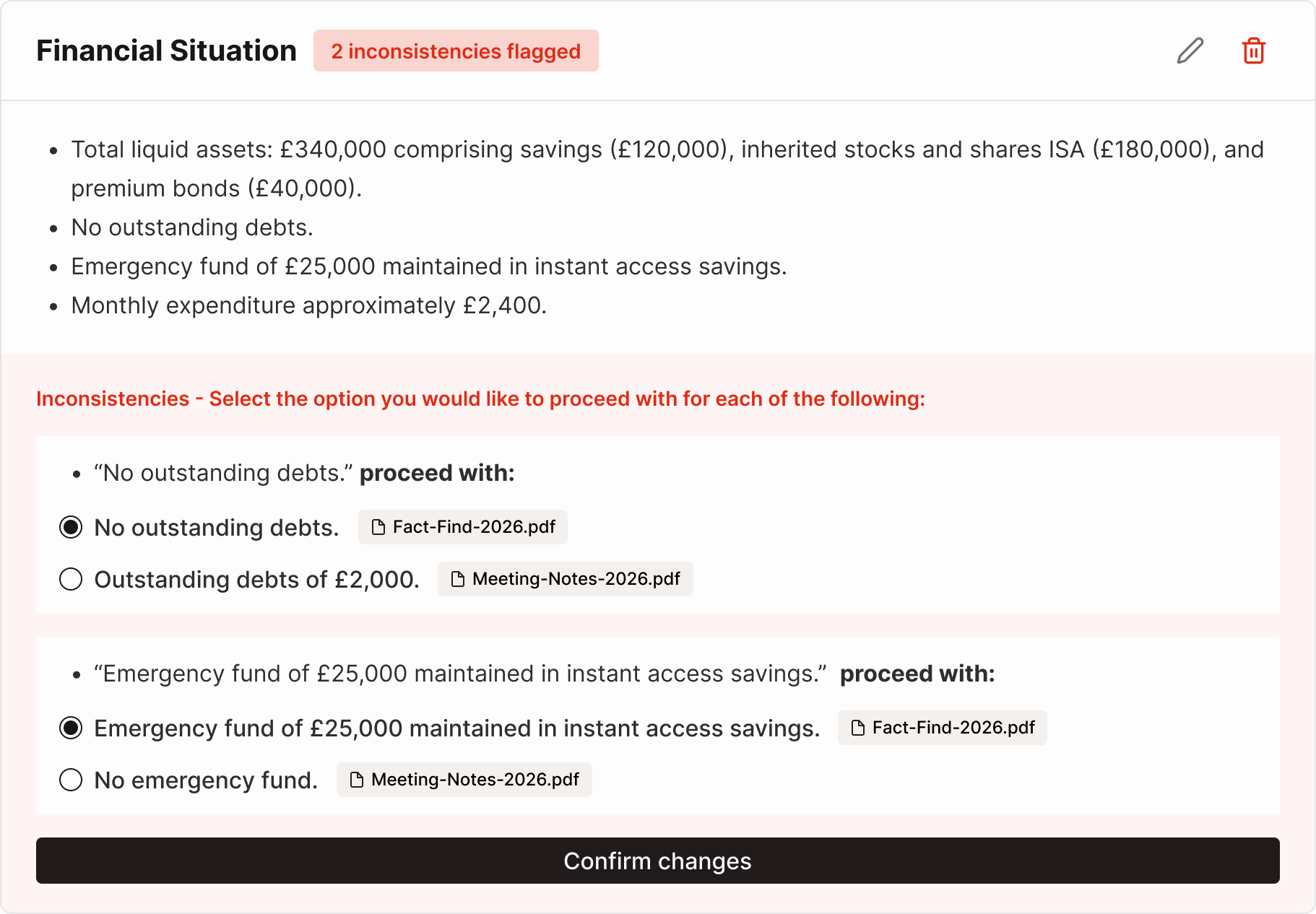
Inconsistencies surfaced for review before report generation, with the source document shown against each option

End to end

Four steps, one platform, an adviser signature at the end.

Select and upload documents, attributing each file to a client
Attribution. Joint clients meant every file needed an owner, so the AI knows whose circumstances it is reading.
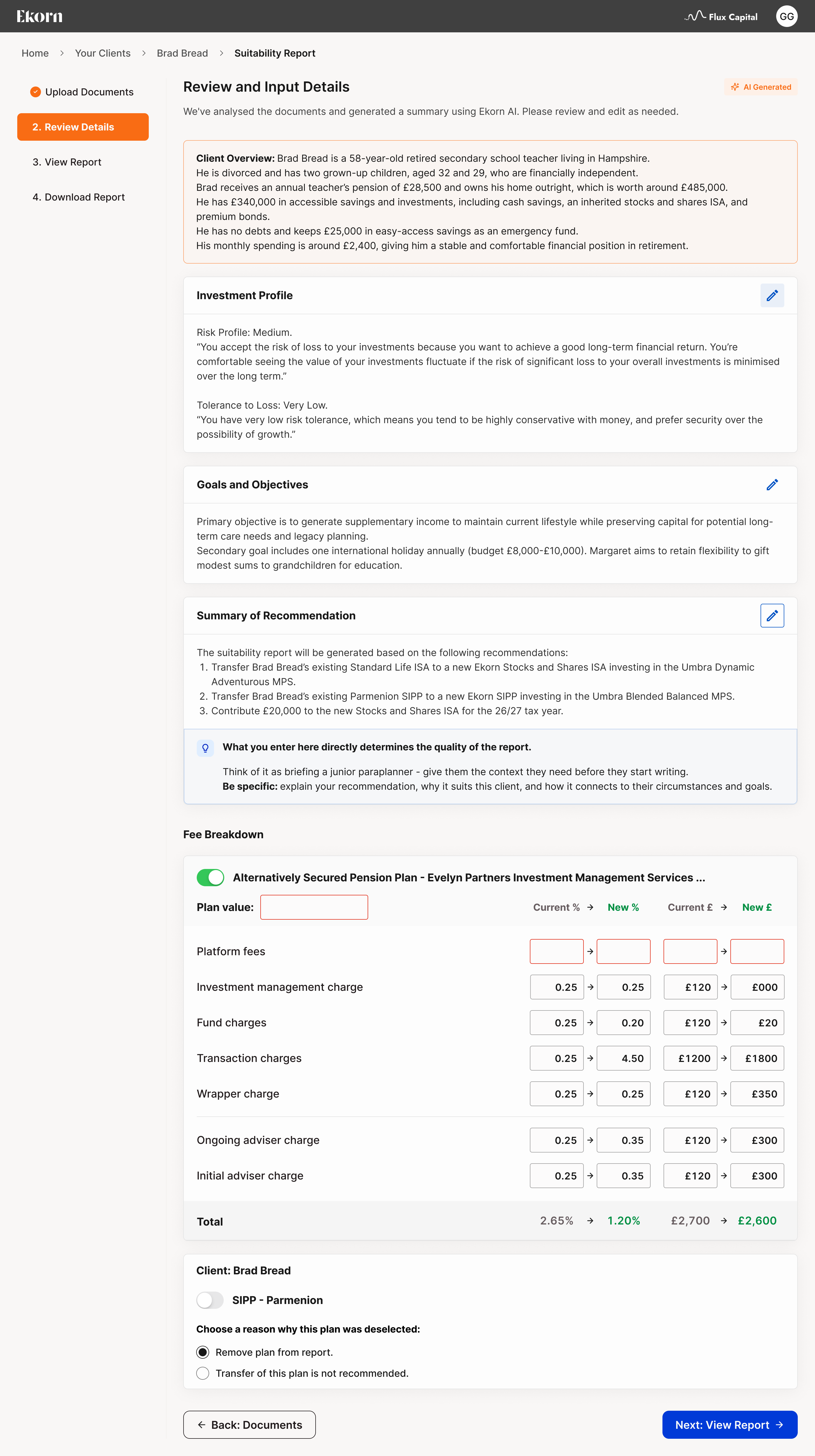
Review and input details — AI summary, profile, goals and fee breakdown
Review before generation. Everything extracted is shown and editable here. What the adviser confirms is what the report is written from.
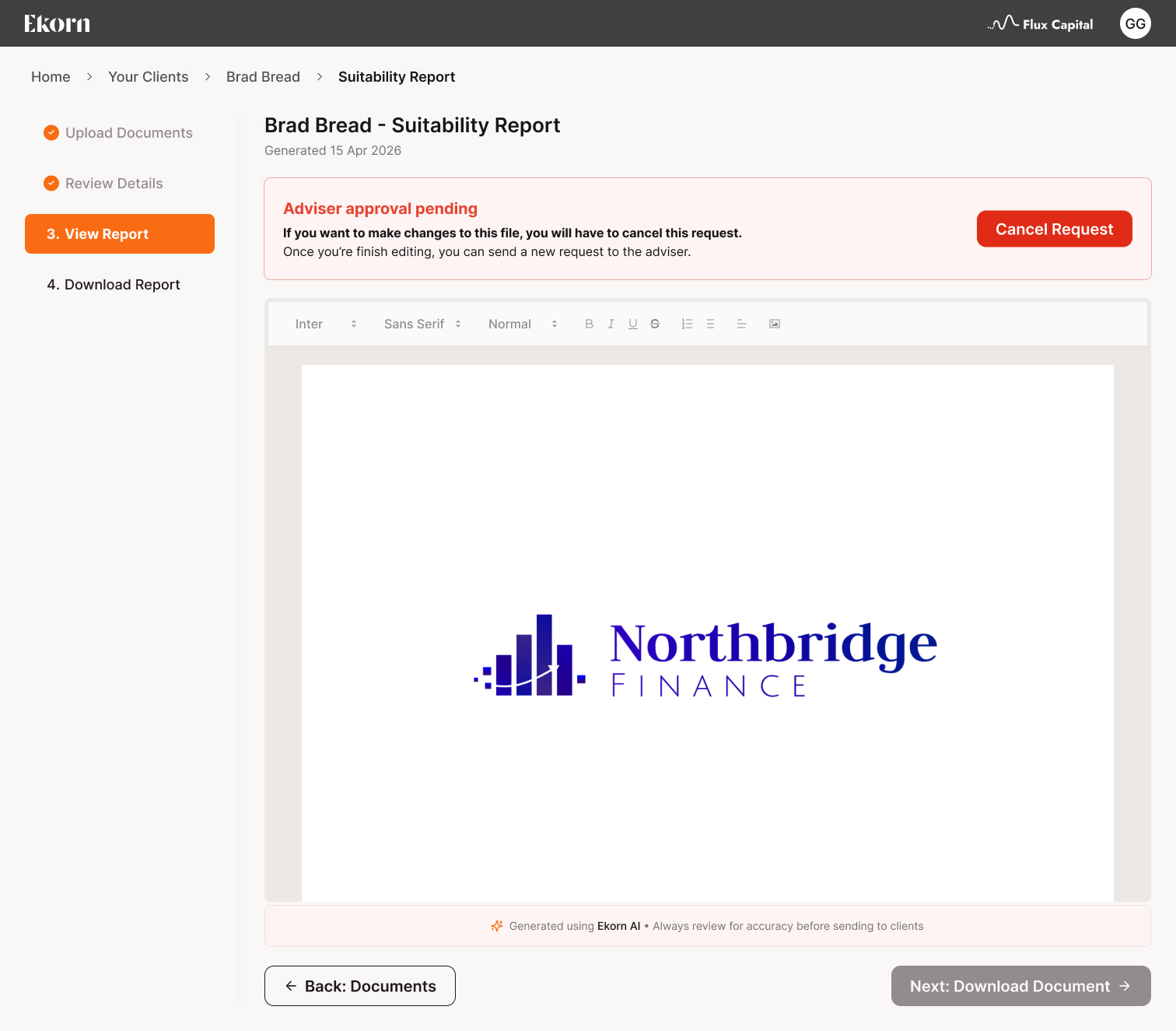
Generated report open in an inline editor, pending adviser approval
Editing in place. The draft opens in a document editor. Editing requires cancelling the approval request, keeping sign-off explicit.
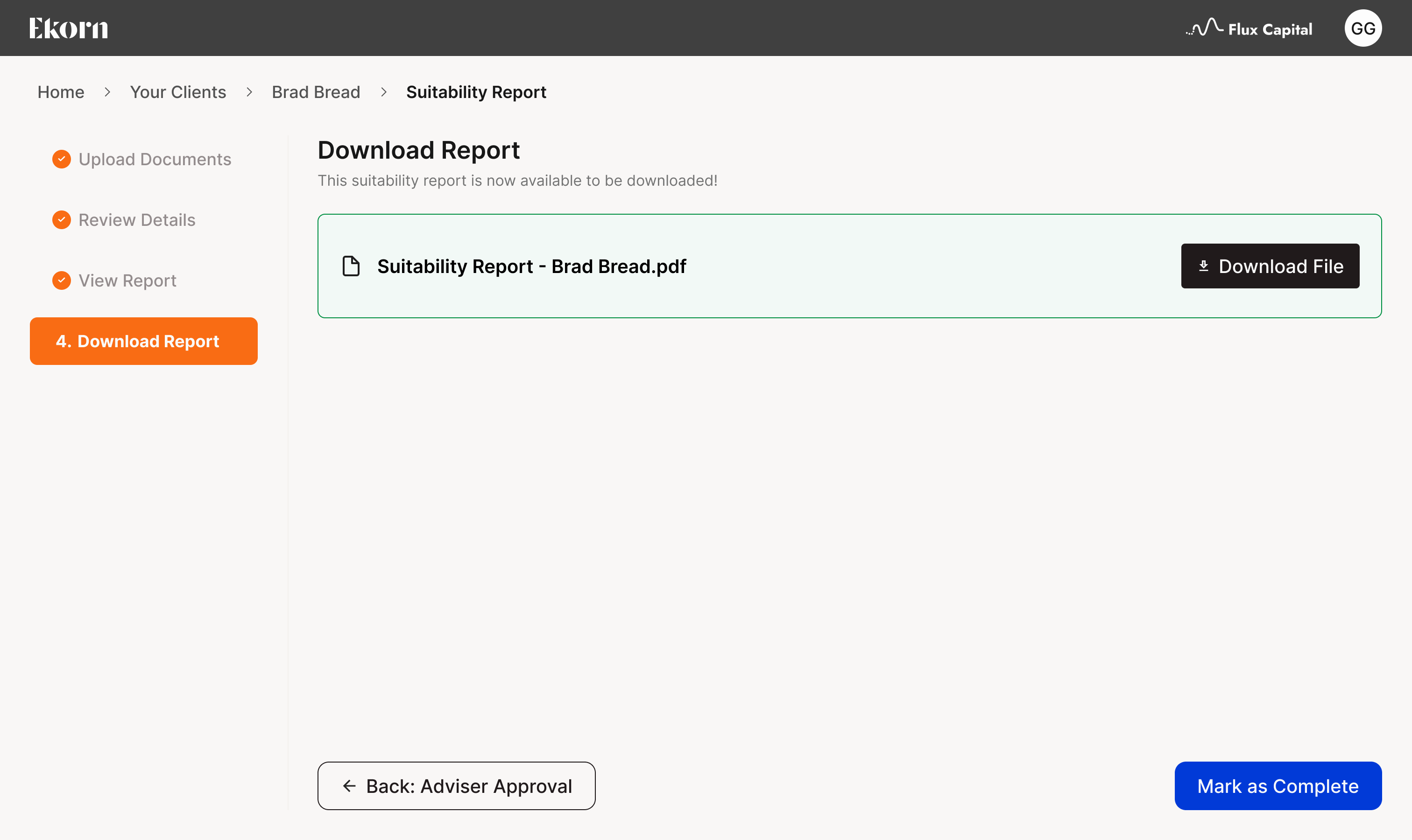
Download report — the completed suitability report PDF
Done. The finished PDF lands back on the client record, ready to send.

Beyond MVP

Firms bringing their own templates

Today generation starts from one controlled template. The direction we're exploring lets a firm upload their own: the system identifies required variables, maps them to trusted client data, and produces a report that preserves the firm's structure and language.

Firm uploads template Detect variables + map sources Personalised report
← Previous caseGreenspark Next case →Doji